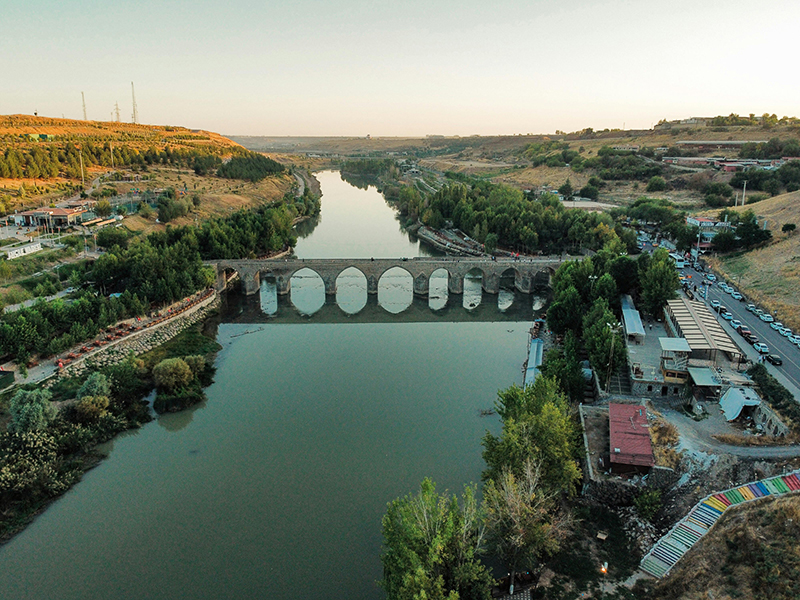
Turkey’s rising dam waters reveal a 2,400-year-old lost city. The dam holds its breath, silent and nearly undetectable. When viewed from above, the Dicle Dam reflects the limitless skies above while blending in perfectly with the river it crosses. It sustains the nearby crops and blends in seamlessly with the lives of those who reside in southeast Turkey.
Its existence and memory are not hurried. However, there is something else hiding beneath the serene exterior. Steps of stone descend into nothing. At strange angles, walls pierced through the water. Carved buildings still stand where they were constructed, although they are now inaccessible. These are not dispersed remnants. They are part of an area that was open long before the dam altered the topography.
Divers operating along the Tigris River near Eğil have begun to record what remains. According to reports from Arkeonews and Türkiye Today, there are remnants of 2,400-year-old religious structures, rock-cut tombs, and remnants of houses. It doesn’t feel like ruins in the conventional sense. It seems like a town that has never truly vanished.
A significant portion of this region was submerged when the dam was finished in the late 1990s. Before the flooding started, some significant locations were relocated, but the majority remained in their original locations. The past settled underneath the reservoir once it was full. It’s unusual because of that.
The majority of historic sites gradually deteriorate. They gradually deteriorate over time. In this case, the opposite occurred. Everything was hidden by the water, which kept it safe.
Scenes where building outlines are still easily discernible have been reported by divers. In certain places, the shapes are so distinct that it seems more like an interruption than a finding, as though life stopped and never started again.
A new universe begins to emerge beneath our feet as the dry season approaches and the rainy season begins. Stones start to light up, remnants of old walls start to appear at the margins, and the ground begins to give us a brief glimpse into the past as if it were releasing its grip on us. But the waves rise once more, and everything comes to an abrupt end.
Dicle Dam was built with a single goal in mind: it is a component of the Southeastern Anatolia Project, which aims to improve infrastructure, boost irrigation, and improve living standards in the area. It was a great success in this regard, but not without consequences.
Under the reservoir, entire neighborhoods vanished. Certain holy locations, such as famous graves, were moved. Some weren’t. Every day, areas, residences, walkways, and meeting places stayed still and gradually merged into the lake.
Nobody anticipated how long some of it would last. Arkeonews reports that because there is no wind, weather, or human interaction to effect the preservation of many elements, the underwater position has actually slowed down the degradation process.
However, gaining access to these facts is not a simple task. This site is not regularly excavated. No digging through the soil to find any mysteries it could have.
Every visit deepens our comprehension, yet the complete image remains elusive, packed with old recollections. Many cultures have arrived in the area, leaving their mark on a particular style of architecture. Another part of the story is hidden beneath the water’s surface. Because the spaces’ functions change over time, several architectural styles coexist. The site has an accumulation of layers layer after layer.
The moment of truth does not occur in the landscape. There are no magnificent monuments that rise from the ground. Nobody congregates at the location. The secret is still hidden beneath the surface. Work continues, but it depends on timing. Water levels fluctuate. Visibility comes and goes. A clearer view is available in some seasons but not in others. Nevertheless, interest has increased.
Beyond the realm of science, there is interest in the notion that a whole landscape still exists underwater. It causes people to stop and consider what might still be concealed in seemingly familiar locations. It also poses an issue for which there is no easy solution.
When we construct something new, what do we retain and what do we discard? The reservoir supports life today. There are remnants of past life in the buildings beneath it. They both reside in the same location.
Source: The Economic Times
Click the link for Property for Sale in Turkey