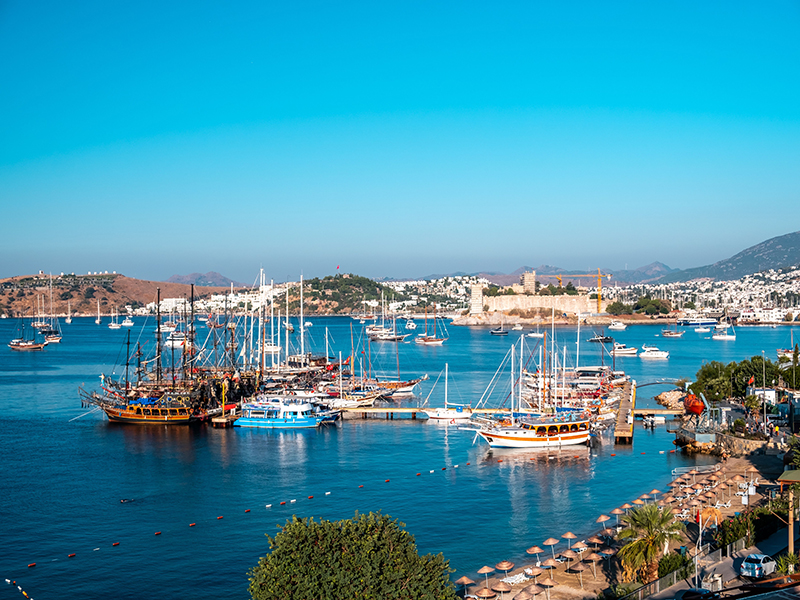
Bodrum the Aegean Dream – but can Turks afford to holiday there now? “You can’t pay a year’s worth of rent on three months of sunshine anymore,” Ahmet Yilmaz says, wrapping a weathered rope around the cleat of his wooden gulet as Bodrum Harbour slowly awakens. Bodrum still sells Aegean dream to tourists—fewer Turks can afford to buy it.
Yilmaz has worked in these Aegean seas for thirty years, recalling the days when sponge divers were getting ready for their boats and fisherman were carrying nets in the mornings. One summer at a time, he observes the peninsula serving increasingly international elite.
His concern reverberates throughout the peninsula. Few locations better demonstrate Turkey’s success than Bodrum, where its permanent population of about 195,000 people surges to over 800,000 during the summer. Last year, Turkey welcomed nearly 64 million foreign tourists, producing a record $65.2 billion in tourism revenue. Beneath those unprecedented figures, however, is a workforce that is wagering its entire year on a few weeks.
Those few summer weeks provide a large portion of the revenue needed to support the remaining nine months of the year for boat captains, hotel staff, restaurant personnel, and merchants.
Yilmaz unties another rope as the first excursion boat leaves the port. He is making every trip this summer to make sure he generates enough money before the season ends.
A life in between the seasons
Nejdet Hallac, 28, greets another group of summer visitors inside a hotel by the sea. He has worked in Bodrum’s tourism sector for a number of seasons and is amiable and quick to grin. Hallac still likes living here in spite of everything.
“Bodrum is peaceful,” he says. “That’s why I like it.” For Hallac, tourism has opened doors that many jobs elsewhere in Türkiye could not.
“We have the opportunity to earn more than someone on the minimum wage,” he says. “As tourism develops, working conditions improve, salaries improve, and we have better opportunities. But inflation changed the value of that money. We may earn more, but our purchasing power keeps falling.”
Hallac has been lucky to stay in the industry, unlike many seasonal workers, but he knows others who spend every winter looking for work when hotels close for the season.
“If tourism continued throughout the year,” he says, “people could build more stable lives. They could settle here instead of planning their lives one summer at a time.”
Hallac doesn’t doubt Bodrum’s achievements. All he wants to know is if those who maintain it will always have a place in it.
Out of paradise prices
The people who truly profit from the tourism boom are being reshaped by the same dynamics that are straining Bodrum’s labor force. Ordinary Turkish families are gradually being priced out of Bodrum entirely as luxury development drives up prices everyplace. It’s not just locals who are being priced out of a steady life.
The superyachts anchored offshore and the opulent hotels developing along the shoreline are hardly the biggest changes in Bodrum, according to Tolga Alan, a resident and cafe owner. Families are the ones who discreetly quit attending.
“When I was younger,” he says, “teachers, civil servants and middle-income families from Istanbul, Ankara and Izmir spent their summers here. They stayed in small pensions or modest holiday apartments. Bodrum wasn’t only for the wealthy.” Today, those holidays have become difficult to justify.
For over 10 years, Fatih Yasar and his wife, who are both in their sixties, vacationed in Bodrum, sometimes as a couple and other times with their entire family. However, they stopped visiting three years ago.
“I still remember what we used to pay,” Yasar says. “Back in 2015, a week for the two of us—hotel, food, everything—was maybe $900 to $1,100. By 2019 that had gone up to $1,200 or $1,500. And by 2023, we were looking at $2,200, sometimes $2,600. This year, the same trip would cost us around $3,000. That’s accommodation, transport, food, all of it.
“For that kind of money, we could spend a week on the Greek islands—Kos, Rhodes—flights, hotel, meals, everything included,” he says. “We still love Bodrum. It’s not that we stopped caring about it. It just stopped making sense financially.”
Their experience is consistent with a larger pattern.
Depending on where they stay and how they travel, a five-day vacation for a family of five departing from Istanbul can cost anywhere from ₺67,000 to ₺140,000 based on current lodging, transportation, and eating expenses. Even before shopping and other personal expenses are taken into account, a nine-day stay during peak season might result in much higher prices.
A single vacation in Bodrum now costs many middle-class families at least one month’s pay. “What used to be an ordinary family holiday has become a luxury,” Alan explains. “People’s affection for Bodrum has not diminished. They can no longer afford it.
The town’s character has subtly changed as a result of that alteration. The beaches are still packed every summer, but many of the office workers, teachers, and government employees who used to come back year after year have been replaced by tourists with far more disposable income.
Millions of people still visit Bodrum. It just welcomes a different Turkey than it used to.
The shaky horizon
Bodrum’s quick rise to the top of the Mediterranean luxury market presents both significant operational challenges and financial benefits for hotel manager Selcuk Ermez.
“Tourism is the engine of the entire peninsula, but managing a luxury footprint on a hyper-seasonal schedule is becoming an extreme balancing act,” Ermez says. “A strong July and August can mask the underlying pressure, but the cost structure of running a hotel here has shifted dramatically.”
In the first half of the year, Bodrum’s ports and airport welcomed almost 410,000 foreign tourists. Peak hotel occupancy reached 80% by July, one of the busiest months of the year, thanks to this momentum. However, the profit margins that keep those companies afloat have tightened considerably. Local operators have been obliged to raise prices in order to break even due to high seasonal inflation, rising energy tariffs, and skyrocketing leasing rates; these price increases are driving out families like the ones Alan recounts.
However, Bodrum now faces direct competition from neighboring Greek islands, Mykonos, and Santorini in addition to neighboring Turkish resorts.
“Our biggest operational hurdle isn’t just international competition—it’s retention,” Ermez explains. “When local housing costs swallow up to 70% of a hospitality wage, keeping experienced, qualified staff year after year becomes nearly impossible. Employees either move inland or leave the sector entirely after the summer ends.”
Demonstrating that Bodrum can draw ultra-high-net-worth tourists is no longer a hurdle for both modest pension owners and luxury hoteliers. It is making sure the town maintains the genuine Aegean flavor that initially made it famous while managing the operational overhead of the eight quiet months.
Following the season
Bodrum starts to release his breath near midnight. The waterfront eateries’ music becomes softer. Superyachts’ reflections ripple across the port, and excursion boats softly rock against the pier. Beyond them, waterfront houses worth between €3 million and €15 million dot the hills of Yalikavak and Turkbuku, signifying a peninsula that has reinvented itself for the world’s wealthiest tourists.
The day is finished for Ahmet Yilmaz. After more than thirty years of repetition, he coils the final rope onto the deck of his wooden gulet.
Yilmaz has never resisted the evolution of the peninsula. He explains, “Tourism brought work, visitors, and opportunities we never imagined,” as he turns to face the shiny superyachts that are just a few meters away from the worn wooden boats that made Bodrum famous.
“But I hope the people who built Bodrum can still have a place in it.” It’s a hope shared far beyond the harbour—that Bodrum can still have a place for the people who used to come, not just the ones who can now afford it.
Source: Turkiye Today
For information on Property for Sale in Turkey please click the link