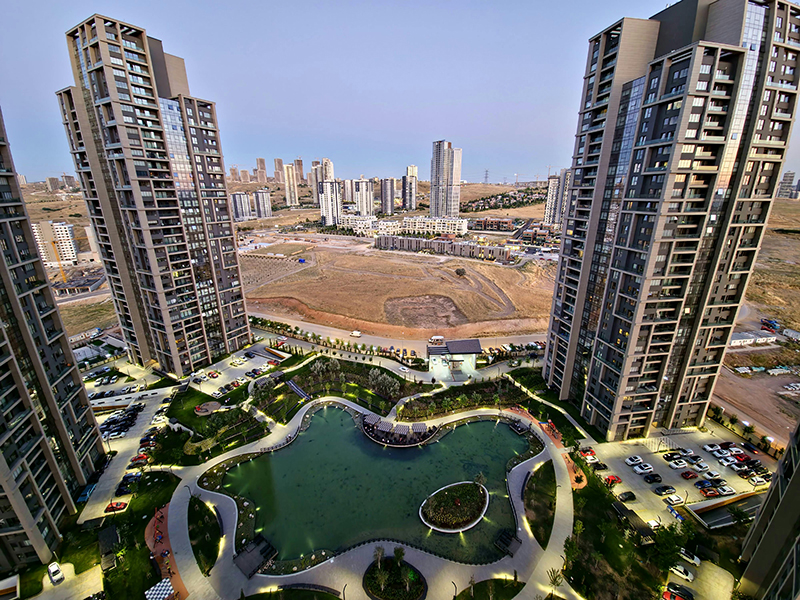
As real estate investors look beyond Dubai, Turkey is on their radar. According to a study on Tuesday, foreign real estate investors are looking for other ways to “create a Plan B” and “risk diversify” in the wake of the crisis between the United States, Israel, and Iran. Turkey stands out among these choices.
The dispute began about a month and a half ago, and after Israeli and American attacks on Iran and Tehran’s counterattack, it developed into a regional issue.
The Middle East crisis is still having a detrimental impact on Dubai, which ranks highly among the places where Turkish citizens buy the most real estate. As a result, property sales in Dubai, which had become a hub for foreign investors, have decreased as a result of the attacks between the United States, Israel, and Iran spreading to other regional nations.
Property sales fell from 17,027 units (between February 2 and March 1) to 11,828 units in the four weeks following the start of the conflict (March 2-29), according to the digital platform DXB Interact, which offers information on the Dubai real estate market. As a result, over the course of a month, the original 25% drop in revenue increased to 30.5%.
According to the Anadolu Agency (AA) report, which cited platform statistics, the transaction volume also fell by 36% in a single month, from $16.53 billion to $10.58 billion. Furthermore, industry representatives claim that because of the conflict, foreign real estate investors are looking for “Plan B” and “risk diversification” options.
Price decline
Haitham Ahmet Alamarioğlu, CEO of Level Immigration and Properties and an expert in international real estate, stated that they anticipate the short- and medium-term fall in Dubai real estate sales. He said that foreign investors would have to wait and see if there was no lasting cease-fire.
“Without a permanent cease-fire, trust will not return, and transaction volumes will not recover without trust,” Alamarioğlu said. “In such scenarios, having a Plan B shifts from precaution to a necessity. Historically, it has taken at least 12-18 months for geo-politically triggered corrections in Dubai to reverse. This time, it might take even longer,” he added.
Additionally, Alamarioğlu stated that early data indicate a 4%-5% drop in prices, adding, however, that the main pressure “hasn’t been fully felt yet.”
“When transaction volumes fall, prices react with a delay. Seller’s first resist lowering prices, the market freezes then the correction comes. A more pronounced correction in the next quarter is highly likely.”
Three alternate routes
Although Alamarioğlu noted that Dubai’s story isn’t over, he contended that the city’s “safe haven” narrative was severely damaged.
“Dubai partially lost its appeal. There’s no sudden exodus, but a gradual rebalancing. Investors are now asking, ‘If I need to exit this market tomorrow, what’s my Plan B if I can’t quickly sell my property and my capital gets stuck here for my family?'”
He continued by saying that three particularly appealing alternative locations for foreign real estate investors are Greece, Panama, and Turkey.
He linked Turkey‘s “citizenship by investment” initiative to the notable rise in demand from buyers in the Gulf and Iran. “This is driven by visa-free entry, cultural proximity, and it being one of the rare accessible ways to obtain full citizenship through property acquisition,” he noted.
He also brought up the “qualified investor programme” in Panama, which offers permanent residency in 30 days, and the Golden Visa programme in Greece.
The CEO of Parcel Estates and an expert in international real estate, Özden Çimen, added that investors are currently in a “wait-and-see” mindset due to recent developments in the Middle East and that panic selling has not yet occurred.
According to Çimen, investors are still drawn to Dubai because of its high rental yields, safe regulatory environment, 0% income tax, and significant liquidity. She also brought up the recent increase following the cease-fire negotiations in the Dubai Financial Market Real Estate Index, which measures shares of real estate companies.
Dubai’s appeal hasn’t diminished, according to Çimen, but foreign investors are expanding their regional horizons. “Recently, investors have been considering locations like London, Lisbon, Istanbul, Miami and Barcelona as additional portfolio destinations. We can view this as a risk diversification strategy.”
Source: Daily Sabah
For more information on Turkish Property for Sale please click the link